
Single-length golf irons are a set in which every club — from the 4-iron through the pitching wedge — is built to exactly the same shaft length, the same shaft weight, and the same swing weight.
In a conventional iron set, each club gets progressively shorter as the loft increases: a standard 4-iron is roughly 39 inches, a 7-iron is 37 inches, and a pitching wedge is around 35.5 inches. Single-length design eliminates this progression entirely. Every club sits at a fixed reference length, most commonly 37–37.5 inches — the equivalent of a standard 7-iron.
Why Variable Length Exists in the First Place
The variable-length convention exists because longer shafts generate more swing speed, and more swing speed produces more distance. A 4-iron with a 39-inch shaft swings faster than a 4-iron with a 37-inch shaft — the additional shaft length creates a longer arc, more leverage, and therefore more clubhead speed at impact.
Equipment engineers designed iron sets with progressively shorter shafts so that the short irons (higher loft, shorter shaft) produce less distance than the long irons (lower loft, longer shaft), creating meaningful distance separation between each club.
What the Single Length Concept Argues
The single length argument is that the benefits of variable length — primarily distance from long irons — come at a significant cost: inconsistency. When every club is a different length, a golfer must make subtle but real adjustments to their stance width, ball position, posture, and swing plane for each different club.
A 4-iron requires a wider stance and a shallower swing than a 9-iron. Most recreational golfers make these adjustments imperfectly and inconsistently, leading to the familiar pattern of reasonably reliable short irons and wildly unreliable long irons.
Single length irons eliminate this adjustment requirement. With every club at the same length, the same stance, the same ball position, and the same swing can theoretically be used for every iron — building one repeatable movement pattern that transfers across the entire iron set.
The Key Engineering Challenge: Maintaining Distance Gaps
Removing shaft length variation removes one of the mechanisms that creates distance separation between clubs. Single length iron designers solve this through two approaches. First, loft progression — each iron has a different loft that creates different launch angles and therefore different carry distances.
Second, progressive CG positioning — the center of gravity in each iron head is individually positioned so that lower-numbered irons (with lower lofts) generate higher launch naturally, while higher-numbered irons (higher lofts) generate a more controlled, lower trajectory. This CG engineering is what separates quality single-length sets from poorly designed ones.
A Brief History: Tom Wishon and Bryson DeChambeau
Tom Wishon, a club designer and author of The Search for the Perfect Golf Club (2005), is widely credited as the father of the modern single-length iron concept. Wishon had been designing and advocating for single-length irons for decades before mainstream adoption, building them through his custom fitting programme for golfers who sought out the concept specifically.
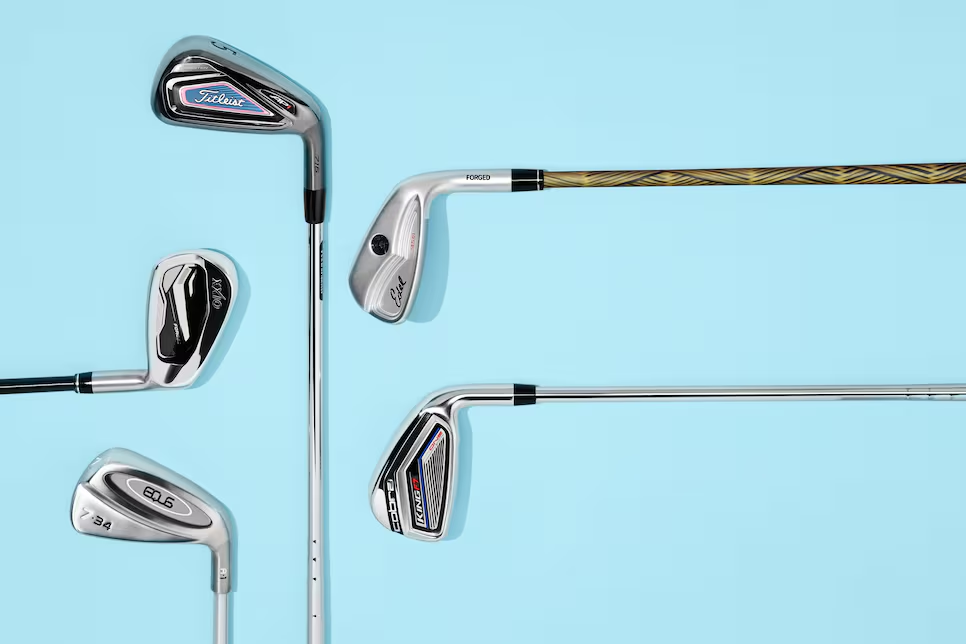
Bryson DeChambeau brought the concept to a mass audience. A physics student at SMU, DeChambeau had independently developed a single-length iron system during his college career — using one swing for every iron based on the premise that identical setup positions produce more consistent mechanics. He won the 2015 NCAA Championship and 2015 US Amateur with single-length clubs, then partnered with Cobra Golf to produce the Cobra King One Length — the first major-brand single-length iron set — which he used to win PGA Tour events in 2018.
💡 Bottom Line: Single length golf irons are not a gimmick — they represent a genuine engineering philosophy with a clear theoretical basis and real-world testing evidence. Whether they work for your specific game is the important question. For tested recommendations across all price points and skill levels, see our full guide to best single length golf irons.