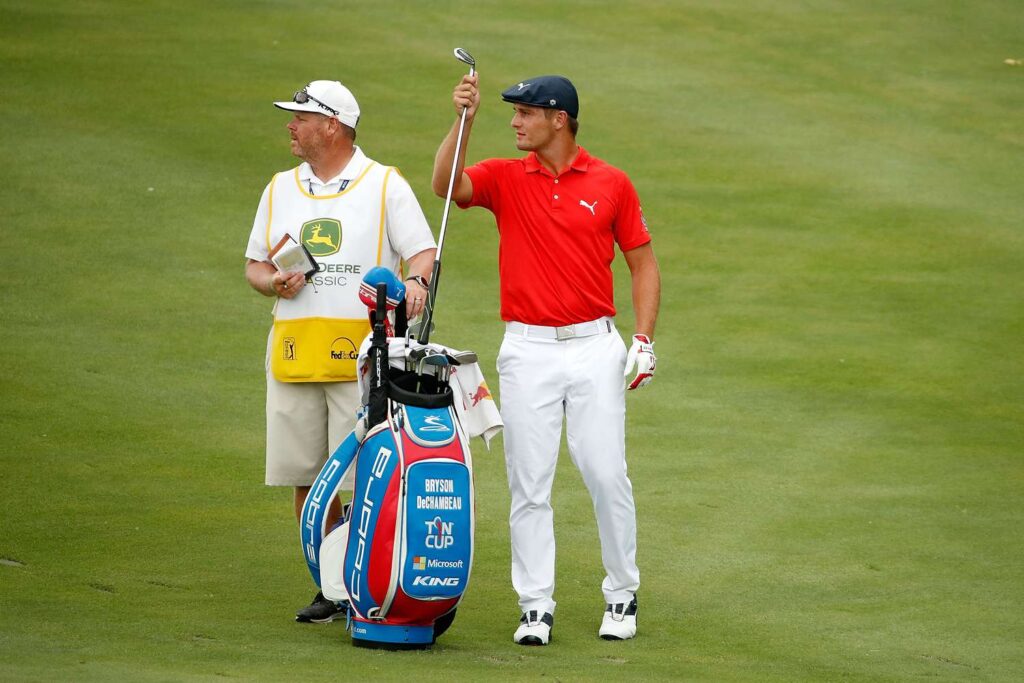
No golfer is more associated with single length irons than Bryson DeChambeau. He popularised the concept, proved it at the highest level of professional golf, and then — in one of golf equipment’s most discussed pivots — walked away from it.
Understanding the full arc of DeChambeau’s relationship with single-length irons is the most useful context any recreational golfer can have when evaluating the concept.
The Origin: SMU Physics and One-Swing Theory
DeChambeau studied physics at Southern Methodist University and approached golf as an engineering problem. His core insight — developed independently from Tom Wishon’s earlier work on the same concept — was that variable-length irons required variable setups, and variable setups introduced variability into the swing.
His solution: standardize the equipment so that one setup and one swing motion could be applied to every iron.
He built his single-length system around 7-iron length, used identical shafts throughout, and adopted an upright, single-plane swing that maximized the consistency benefit of the uniform setup.
The results in college golf were immediate: he became the fifth player in history to win the NCAA Division I Championship and the US Amateur in the same year (2015), joining Jack Nicklaus, Phil Mickelson, Tiger Woods, and Ryan Moore.
The Cobra Partnership and PGA Tour Success
DeChambeau turned professional in 2016 and partnered with Cobra Golf, who invested in developing the Cobra King One Length — the first major-manufacturer single-length iron set built to his specifications. The clubs incorporated progressive CG positioning per iron (to maintain distance gaps despite uniform shaft length) and were available to recreational golfers through Cobra’s standard retail channels.
His PGA Tour results with single-length irons were genuine. He won the 2017 John Deere Classic (his first PGA Tour win), the 2018 Dell Technologies Championship, the 2018 Northern Trust, and the 2018 Tour Championship — four wins in a single FedEx Cup playoff season — all while playing Cobra One Length irons.
He ranked consistently in the top 20 for Strokes Gained: Approach, demonstrating that single-length irons were not a limiting factor at the highest level of professional golf.
The Pivot: Why He Switched Away
Around 2019–2020, DeChambeau began his now-famous distance maximization project — adding significant muscle mass and reorienting his entire game around generating the highest possible clubhead speed with every club. This strategy fundamentally changed his equipment requirements.
The critical technical reason for switching: at elite swing speeds (DeChambeau was generating 120-125mph with his irons by 2020), conventional variable-length long irons generate meaningfully more clubhead speed than single-length equivalents — because longer shafts create a longer arc and more leverage at extreme swing speeds. The 2-inch difference between a standard 4-iron (39 inches) and a single-length 4-iron (37 inches) that produces minimal performance impact at 85mph produces a significant distance difference at 120mph.
His need to maximize distance from every club made that 2-inch difference unacceptable.
He completed the transition to conventional variable-length irons around 2021. He won the 2020 US Open during the transition period.
What This Means for Recreational Golfers
DeChambeau’s switch is frequently cited as evidence that single-length irons don’t work. This interpretation is wrong. His switch was a performance optimization for a swing speed that is three standard deviations above the average recreational golfer. The distance loss from single-length long irons that was unacceptable at 120mph swing speed is a marginal concern at 85mph — which is where the average recreational golfer operates.
The consistency benefit that single-length irons provided DeChambeau — tighter long iron dispersion through a uniform setup — remains equally valid for recreational golfers. His switch tells you something important about single-length irons at 120mph swing speed. It tells you nothing about single-length irons at 80–95mph swing speed. For tested options suited to recreational swing speeds, see our single length irons recommendations.