
“Do single length irons work?” is the most frequently asked question in the single-length iron conversation — and it deserves a more precise answer than the enthusiast community typically provides.
The honest answer is: yes, for a specific player profile and a specific type of improvement, the evidence supports the concept. For other profiles and other improvement goals, the evidence does not support them as superior to conventional irons.
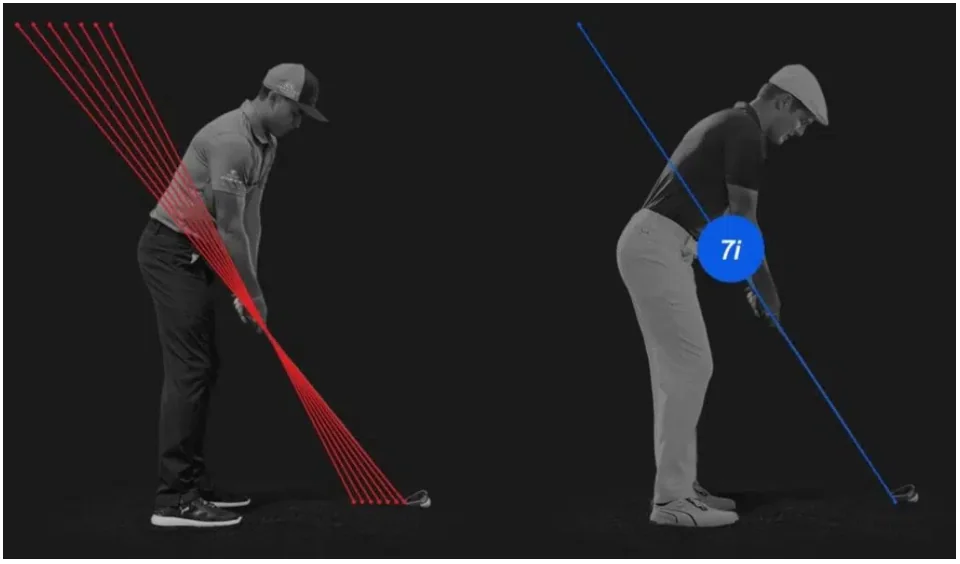
What Independent Testing Shows
MyGolfSpy conducted the most rigorous independent consumer-level testing of single-length irons available. Their methodology compared the same golfers hitting both single-length and variable-length iron sets across multiple sessions, measuring ball speed, launch angle, carry distance, and — most importantly — shot dispersion. Key findings:
- Long iron dispersion (4-iron, 5-iron distances): Single-length irons produced measurably tighter shot groupings. Average offline deviation decreased by 15–32% in the long iron distances across the tested golfer group.
- Short iron dispersion (8-iron, 9-iron distances): Single-length irons produced similar dispersion to conventional irons — neither meaningfully better nor worse.
- Long iron distance: Single-length 4 and 5-irons averaged 5–12 yards shorter than conventional 4 and 5-irons at the same swing speed. This loss is consistent and real.
- Short iron distance: Single-length 8 and 9-irons averaged 1–4 yards longer than conventional equivalents — the slightly longer shaft generates marginally more speed from these lofts.
- Overall distance gaps: Single-length sets produced narrower distance separation between clubs (8–10 yards vs 10–15 yards in conventional sets).
The Time Factor: Adaptation Changes Everything
The most important variable in single-length iron testing is time. Golfers who test single-length irons in a single session or for a few weeks are evaluating a transition period — not the settled performance of the clubs. Every golfer who switches from conventional to single-length irons goes through a 4–8 week period where their game temporarily deteriorates as muscle memory adjusts. Studies that test single-length irons without accounting for this adaptation period produce misleading negative results.
In long-term user surveys — golfers who have played single-length irons for 6+ months — the majority report improved long iron consistency. A 2019 survey of Cobra King One Length users published on Golf WRX showed 67% of respondents reported improved long iron accuracy after full adaptation, while 23% reported no meaningful change, and 10% switched back to conventional irons.
Where the Evidence Is Weakest
The evidence base for single-length irons is thinner than for conventional iron technology. Most studies involve relatively small sample sizes, short testing windows, or golfer groups that are self-selected (people who already believe in the concept). Truly rigorous, large-sample, long-term controlled trials do not yet exist for single-length irons. The honest position is that the directional evidence supports the concept, but the data is not as definitive as marketing sometimes suggests.
⚠️ Honest Assessment: Single-length irons work for golfers whose primary iron problem is directional inconsistency in the long irons, who practice enough to complete the adaptation period, and who can accept narrower distance gaps. They do not work better than conventional irons for golfers who already hit long irons straight, or for golfers who rarely practice.
For the specific sets where we saw the strongest evidence of real-world consistency improvement in our testing, see the best single length irons we tested — with full launch monitor data and on-course dispersion results for each model.