
If you’ve been playing golf for a while and someone calls you a mid handicapper, it means you’re right in the middle of the skill spectrum — no longer a beginner, not yet a scratch golfer.
You can play a consistent round, you understand the fundamentals, and you’re the type of golfer actively working to get better. Understanding exactly what your handicap means — and what it should tell you about your equipment — is one of the most practical things you can do for your game.
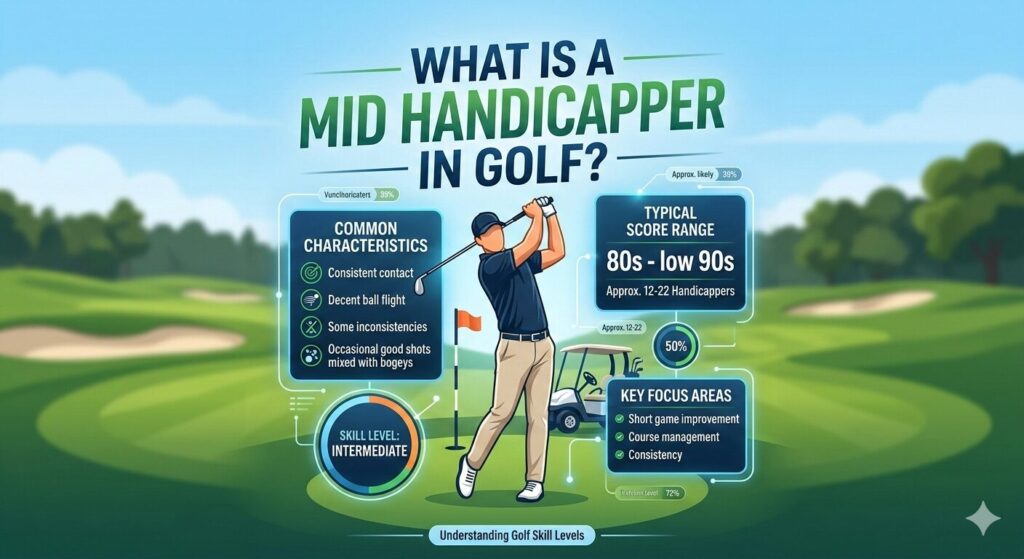
The Official Definition of a Mid Handicapper
A mid handicapper is a golfer carrying a handicap index between 10 and 20. In practical terms, this means you’re typically shooting somewhere between 82 and 95 on a standard par-72 course, depending on the difficulty of the course you play.
You represent the single largest segment of recreational golfers — the majority of club golfers worldwide fall within this range.
The World Handicap System (WHS), which governs official handicaps globally since 2020, defines a mid handicapper based on playing ability rather than just score. Your handicap index is calculated from your best 8 scores out of your last 20 rounds, adjusted for course difficulty.
The Complete Handicap Spectrum — Where Do You Fit?
| Handicap Range | Category | Typical Score | Description |
| +4 to 0 | Scratch / Elite | Even par to 68 | Tour-level amateur, exceptional ball striker |
| 1 to 9 | Low Handicapper | 73–80 | Consistent ball striking, plays most par 4s in regulation |
| 10 to 18 | Mid Handicapper ✅ | 82–91 | Solid fundamentals, occasional great holes, some costly mistakes |
| 19 to 28 | High Handicapper | 92–100 | Developing game, inconsistent contact, working on basics |
| 29+ | Beginner / High | 100+ | Learning the game, building fundamentals |
As a mid handicapper your game is characterized by several specific traits: you hit some greens in regulation (typically 3–7 per round), you make occasional pars and sometimes birdies when everything clicks, but you also drop shots from avoidable mistakes — a three-putt, a pull into the trees, or a slightly mishit iron that comes up short of the green.
You’re consistent enough to have a real handicap but inconsistent enough that forgiveness in your equipment still genuinely matters.
Mid Handicapper Sub-Categories — It’s Not One-Size-Fits-All
The term ‘mid handicapper’ covers a wide performance range, and it’s worth understanding exactly where within that range you fall because it significantly affects what equipment is right for you:
| Handicap | Sub-Category | Equipment Implication |
| 10–12 | Low-Mid | Player’s distance irons — developing toward single digits |
| 13–15 | True Mid | Player’s distance or GI irons — sweet spot of mid handicap category |
| 16–18 | Mid-High | Game improvement irons recommended — forgiveness still critical |
| 19–20 | High-Mid / Bogey Golfer | Full game improvement irons — consistency is the main goal |
What Is a Bogey Golfer?
A bogey golfer is someone who averages one bogey per hole — shooting approximately 90 on a par-72 course. This typically corresponds to a handicap of around 17–20.
If you identify as a bogey golfer, you sit at the higher end of the mid handicapper spectrum.
The equipment recommendations for a bogey golfer and a high-mid handicapper are essentially identical: maximum forgiveness, strong lofts, and a sole design that aids turf interaction.
What About a 12 Handicapper? A 10 Handicapper? An 18 Handicapper?
These specific handicap levels have different equipment implications:
- 12 handicap: A 12 handicapper is in the sweet spot for player’s distance irons like the TaylorMade P790 — enough skill to appreciate feel and workability, still benefits from GI-level forgiveness.
- 10 handicap: A 10 handicapper is approaching single digits and should be transitioning toward more compact irons with less offset and more feedback.
- 18 handicap: An 18 handicapper still needs full game improvement iron characteristics — forgiveness, launch assistance, and sole designs that reduce turf interaction errors.
- 20 handicapper: A 20 handicapper sits right on the border of mid and high handicap. Game improvement irons are clearly the right choice.
How Is a Handicap Calculated?
Your handicap index is calculated using the Handicap Differential formula: (Adjusted Gross Score − Course Rating) × 113 ÷ Slope Rating. Your index is the average of your best 8 differentials from your last 20 rounds.
The WHS system means your handicap is genuinely portable across any course in the world — a 15 handicap at Augusta would produce a similar result to a 15 handicap at your local municipal course when course and slope ratings are applied.
Does Your Handicap Tell You What Irons to Buy?
Your handicap is the single most useful data point for iron selection. It directly maps to the iron categories that will most benefit your game:
| Your Handicap | Best Iron Category | Top Pick |
| 8–12 | Player’s Distance | TaylorMade P790 or Titleist T150 |
| 13–16 | Game Improvement / Player’s Distance | Mizuno JPX925 Hot Metal or Callaway Paradym Ai Smoke |
| 17–20 | Game Improvement | Callaway Paradym Ai Smoke or Wilson DYNAPWR Max |
For a complete breakdown of exactly which irons suit your handicap level, including performance data and price comparisons across 10 top models: best golf irons for mid handicappers — our full tested guide