What Is a Blade Golf Iron?
The blade iron is the oldest, purest iron design in golf — and it remains the weapon of choice for the world’s best ball-strikers. Here’s exactly what it is, how it works, and why it polarises golfers so sharply.
The Core Definition
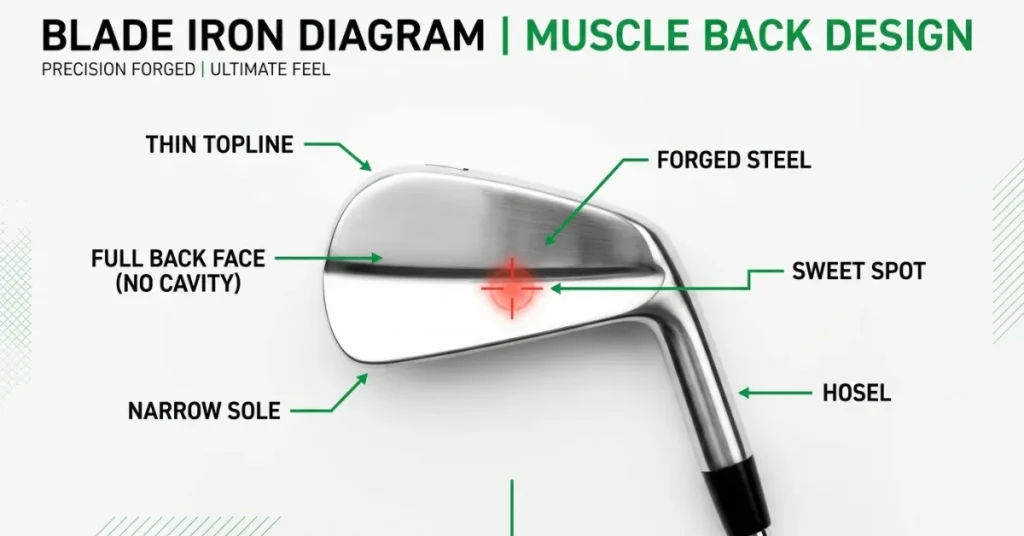
A blade golf iron — sometimes called a “muscle back” — is an iron where the mass of the clubhead sits primarily behind the centre of the face, distributed across a thin, compact profile with no cavity at the back. The result is a small sweet spot, an extremely thin topline, a narrow sole, and sensory feedback that tells you exactly — and brutally — where you made contact.
Compare that to a cavity back iron, which redistributes weight to the perimeter of the head. That perimeter weighting increases the Moment of Inertia (MOI) — the iron’s resistance to twisting on off-centre strikes — creating a larger effective sweet spot and a more consistent ball flight even on mishits.
Blades have no such safety net. When you miss the centre of a blade face, you feel it immediately through vibration, hear a duller click, and see the ball flight deviate. This is the defining characteristic — not a flaw, but a feature for players who need that information to improve.
The Three Blade Iron Subtypes
The term “blade” is used loosely in the industry. In reality there are three distinct designs:
1. Pure Muscle Back (True Blade)
A solid, flat back with no cavity whatsoever. All weight is concentrated directly behind the sweet spot. Examples: TaylorMade P7MB, Titleist T100 3G. Maximum workability, maximum feedback, minimum forgiveness. Used almost exclusively by scratch-to-plus handicappers and tour players.
2. Muscle Cavity (Combo Back / CB)
A shallow cavity milled into the back of the blade-profile head. This moves a small amount of weight toward the perimeter without fundamentally altering the blade look at address. Examples: TaylorMade P770, Cobra King CB/MB. Slightly more forgiving than a pure blade but retains the compact look and workable flight.
3. Player’s Distance Iron
A blade-inspired aesthetic with modern internal engineering — hollow construction, variable face thickness, or speed foam fill for added distance. Examples: TaylorMade P790 (2025). These look like blades at address but perform closer to a player’s cavity back. Aimed at low-to-mid handicappers who want the look without the full penalty of a pure blade.
The Anatomy of a Blade Iron
Understanding what makes a blade look and perform the way it does comes down to five design elements:
| Design Element | Blade Iron | Cavity Back |
|---|---|---|
| Topline thickness | Very thin (3–4mm) | Thick (5–8mm) |
| Sole width | Narrow (sharper leading edge) | Wide (more ground interaction) |
| CG location | Centred behind face | Perimeter distributed |
| MOI | Low (less twist resistance) | High (more twist resistance) |
| Feedback | Immediate, detailed | Muted, forgiving |
Why the Feel Is Different
Feel in irons is a function of materials, construction, and CG position. Blade irons — especially those made from soft carbon steel via a forging process — provide vibration transmission that cavity backs physically cannot replicate. The mass directly behind the face means impact energy is transferred directly into your hands. A well-struck blade 7-iron produces a soft, almost muffled “thud” that experienced golfers describe as the gold standard of iron feel.
A mishit produces the opposite: a stinging vibration that tells you immediately the strike was heel or toe-heavy. This is the double-edged sword of the blade — it rewards good technique and exposes poor technique, often in the same round.
Workability: The Key Advantage
The centred CG of a blade iron makes it significantly easier to manipulate ball flight. When you want to hit a controlled draw, the blade’s design responds predictably to a closed face angle and in-to-out path. A fade works the same way in reverse. Cavity backs — especially game improvement irons — are specifically engineered to resist off-axis shots and self-correct flight, which is great for consistency but limits shot shaping.
Tour players who need to work the ball under a tree branch, fire a low bullet into a links headwind, or spin a mid-iron back toward a front pin rely on this workability as an essential tool. For amateur golfers who can already control their contact, the same advantages apply.
Who Should (and Shouldn’t) Play Blades
Blade irons suit golfers who:
- Strike the ball consistently from the centre of the face
- Prioritise feel and feedback over forgiveness
- Want to shape shots intentionally
- Have a handicap of 8 or lower (though this varies — see below)
- Practice regularly with a structured ball-striking focus
Blade irons are unlikely to help golfers who:
- Have a handicap above 15 and inconsistent ball striking
- Struggle with strike location across the face
- Need extra launch help from long irons
- Prioritise distance over control and feedback
The Bottom Line
A blade iron is the most traditional, precise, and feedback-rich tool in the iron category. It is not a beginner’s club and it is not a forgiveness iron — it is a craftsman’s instrument for golfers who have earned the right to use one through consistent ball-striking. If you’re close to that level, see our full guide to best blade golf irons to find your best match.