The short answer is yes — almost every mid handicapper should get custom fitted for golf irons.
The longer answer involves understanding exactly what fitting changes at the mid handicap level, what it costs, and what realistic gains you can expect.
If you’ve ever wondered whether a fitting is worth it for your game, this guide gives you the complete honest picture.
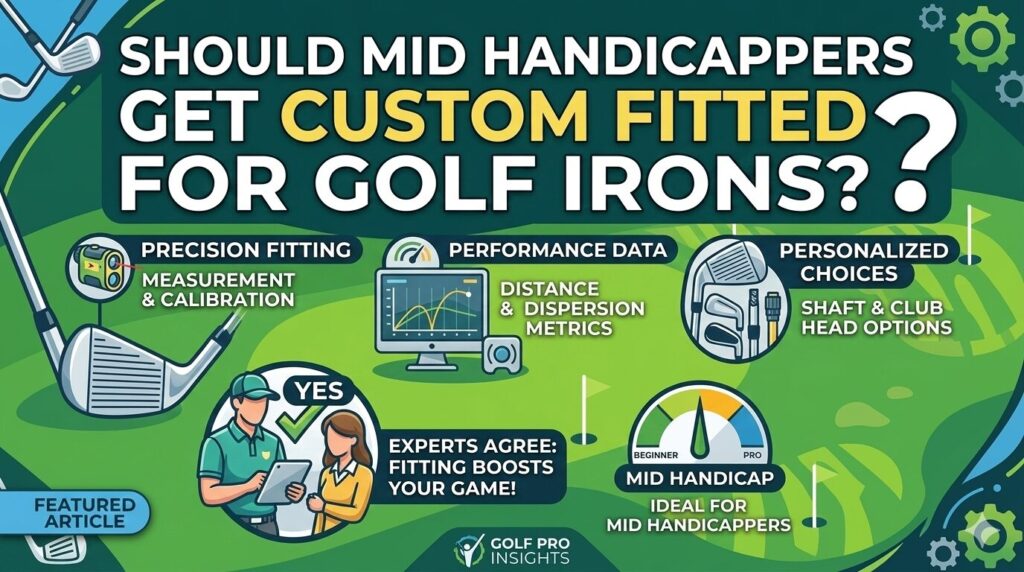
What Gets Custom Fitted in a Golf Iron Session?
| Fitting Variable | What It Means | Impact for Mid Handicapper |
| Shaft Flex | Regular, Stiff, X-Stiff based on swing speed | 5–15 yards added, direction improved |
| Shaft Weight | 65g graphite to 130g steel | Consistency and control improved |
| Club Length | Standard ±1 inch based on height + wrist-to-floor | Strike quality and direction significantly improved |
| Lie Angle | Flat to upright based on swing path | Direction control — most impactful for mid handicappers |
| Grip Size | Undersize to oversize based on hand size | Reduces tension, improves consistency |
| Loft/Offset | Some manufacturers offer adjustable loft/offset | Launch angle and direction fine-tuned |
Lie Angle — The Most Impactful Fitting Variable for Mid Handicappers
Of all the fitting variables, lie angle typically produces the most immediate impact for mid handicappers. Lie angle is the angle between the shaft and the ground when the iron rests at address.
If the lie angle is too upright for your swing, the toe digs into the ground at impact and the face closes — pulling shots left. Too flat and the heel digs in — pushing shots right.
The standard lie angle on irons is manufactured for a golfer of approximately 5’10” with average proportions. Taller golfers, shorter golfers, and golfers with flat or upright swing planes will almost always benefit from lie angle adjustment.
For a mid handicapper whose primary direction problem is consistent left or right misses, lie angle is the single most effective fitting adjustment.
The Real Cost of Custom Iron Fitting
| Fitting Type | Cost (Approximate) | What’s Included |
| Basic retail fitting | Free–$50 | Shaft flex, length check — limited options |
| Standard custom fitting | $50–$150 | Shaft, length, lie angle, grip — most variables |
| Premium studio fitting | $150–$300 | Full Trackman/GCQuad session, all variables, multiple shaft options |
| Brand-specific fitting | Often free with purchase | Limited to that brand’s shafts and specs |
KEY INSIGHT: Most premium iron brands (TaylorMade, Callaway, Ping, Titleist) offer fitting credit that applies the fitting cost toward the iron purchase. A $100 fitting that ensures you buy the right irons is almost always worth it when spending $800–$1,300 on a set.
What Realistic Gains Can a Mid Handicapper Expect From Fitting?
- 5–15 yards added to every iron from correct shaft flex and weight
- Tighter dispersion — typically 15–25% reduction in left-right spread from correct lie angle
- More consistent distance — correct shaft weight reduces distance variation between best and worst shots
- Better feel at impact — correctly fitted shafts transmit the right amount of vibration for your swing
When Is Fitting NOT Worth It for a Mid Handicapper?
Fitting is less valuable — though still beneficial — in two situations: if you’re buying budget irons under $500 where the cost of fitting approaches the cost of the irons themselves, or if you’re a 19–20 handicapper with significant swing flaws that are about to be worked on with a coach.
Getting fitted before a swing overhaul means you may need refitting afterward. In these cases, buy standard specs and invest in lessons first.
Which Mid Handicap Irons Offer the Best Custom Fitting Options?
Ping, TaylorMade, Callaway, and Titleist all offer extensive custom fitting options across their mid handicap iron ranges. For our full breakdown of fitting availability per model: our mid handicapper iron recommendations — includes fitting availability per brand