
Most golf practice advice is generic. Hit more balls. Work on your fundamentals.
Spend time on the range.
This guide is specific to mid handicappers improving their iron play — the drills are chosen because they address the exact problems that separate a 15 handicapper from a 10 handicapper, and a 10 handicapper from a single-digit player.
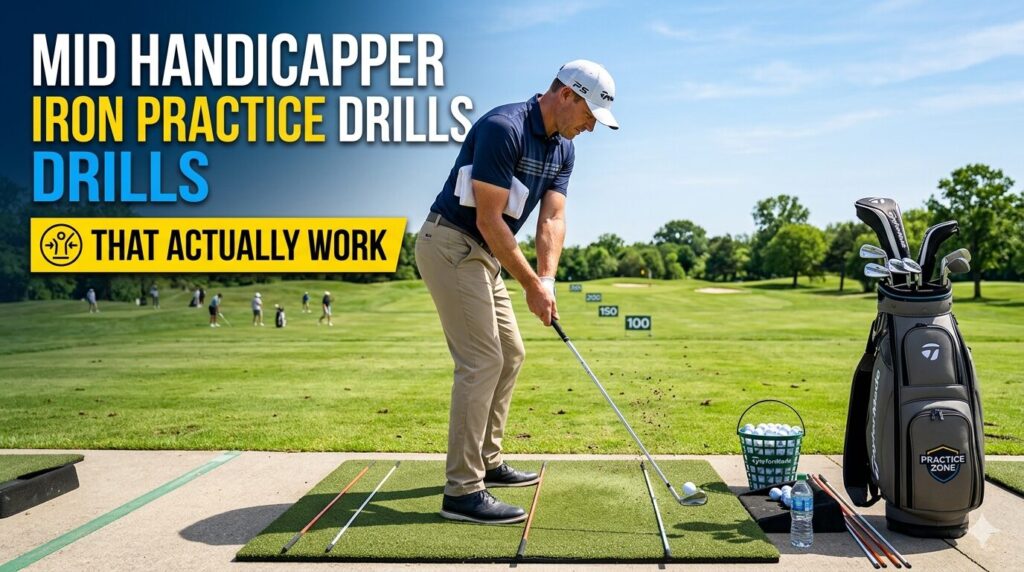
The 3 Core Iron Problems Mid Handicappers Need to Fix
Before drilling randomly, identify which of these three problems affects your game most:
- Inconsistent strike quality — chunking, thinning, or significant toe/heel hits multiple times per round
- Inconsistent distance control — same club produces 135 yards one shot and 150 the next
- Direction problems — consistent misses in one direction that add strokes throughout the round
Drill 1: The Divot Board Drill (Strike Quality)
This is the single most effective iron contact drill for mid handicappers. You need a divot board or impact tape — both available for under $30 on Amazon.
How to do it:
- Place impact tape on the face of your 7-iron
- Hit 10 balls at a specific target — note the impact location on the tape after each shot
- Optimal contact is centered or fractionally toward the toe — heel strikes cost the most distance
- For divot board: place ball at the leading edge of the board — your divot should start AT the ball, not behind it
Do this drill for 15 minutes at the start of every range session before hitting any full shots. Within 4–6 sessions, your low point consistency will improve measurably.
This drill directly translates to fewer chunked and thinned irons on the course.
Drill 2: The Gate Drill (Direction Control)
For mid handicappers with consistent direction problems — particularly pushes or pulls with irons.
How to do it:
- Place two tees in the ground approximately 4 inches apart — just wider than your clubhead
- Address the ball between the tees with minimal clearance on heel and toe sides
- Hit shots through the gate — any contact with the tees indicates swing path or face angle issues
- Move gate progressively closer as your path improves
This drill exposes over-the-top swing paths (the most common cause of pulls and slices in mid handicappers) and trains the correct inside-to-square path that produces straight, powerful iron shots.
Drill 3: The 9-Shot Box Drill (Shot Shaping and Control)
This is the best drill for mid handicappers moving toward single digits. It develops the iron control that separates a 10 handicapper from a 7.
How to do it:
- Imagine a 3×3 grid of 9 targets: left-low, center-low, right-low / left-mid, center-mid, right-mid / left-high, center-high, right-high
- Using your 7-iron, attempt to hit each of the 9 shots in sequence: draw-low, straight-low, fade-low, then the same at mid and high trajectory
- Score yourself: 1 point for each shot that achieves the intended combination of direction and height
This drill forces conscious control of both face angle and swing path, which is exactly the awareness that low handicappers have and mid handicappers are developing.
Drill 4: The Yardage Ladder Drill (Distance Control)
Inconsistent distance is one of the biggest score killers for mid handicappers. This drill builds reliable distance control with every iron
How to do it:
- On a range with distance markers, take your pitching wedge
- Hit 5 shots at 80 yards, then 5 at 90 yards, then 5 at 100 yards using swing length adjustment, not speed
- Note actual carry distances vs intended. Identify which clubs and distances are inconsistent
- Work through every iron from PW to 6-iron over multiple sessions
Most mid handicappers discover their distance gaps are not evenly distributed — often finding two irons with very similar carry distances and a significant gap between others. This drill identifies the problem clubs and builds the muscle memory to address them.
Drill 5: The On-Course Practice Round Drill (Transferring Range to Round)
All range practice is meaningless if it doesn’t transfer to the course. Every month, play one deliberate practice round where you take two balls and follow this protocol: hit your first ball normally.
Before hitting the second, commit to a specific shot shape, trajectory, and target. Note whether the committed second ball performs better or worse than the instinctive first ball.
This builds the pre-shot routine and commitment pattern that distinguishes single-digit golfers from mid handicappers.
Which Irons Best Support These Drills?
The divot and gate drills work with any iron. The 9-shot box drill benefits from a player’s distance iron that provides the feedback and workability needed to intentionally shape shots.
For mid handicappers ready to incorporate shot shaping into their practice: best golf irons for mid handicappers — includes player’s distance picks for developing shot makers