
One of the most common questions left-handed golfers ask before purchasing new irons is whether the left-hand version of a club performs identically to the right-hand version — or whether mirror-image manufacturing introduces any performance differences.
The answer matters practically: if you are relying on right-hand review data (carry distances, launch angles, ball speeds) to inform a left-hand purchase, you need to know whether that data transfers directly.
✅ The Short Answer: Yes — left handed and right handed versions of the same iron model perform identically. All published performance data applies directly to left-hand configurations.
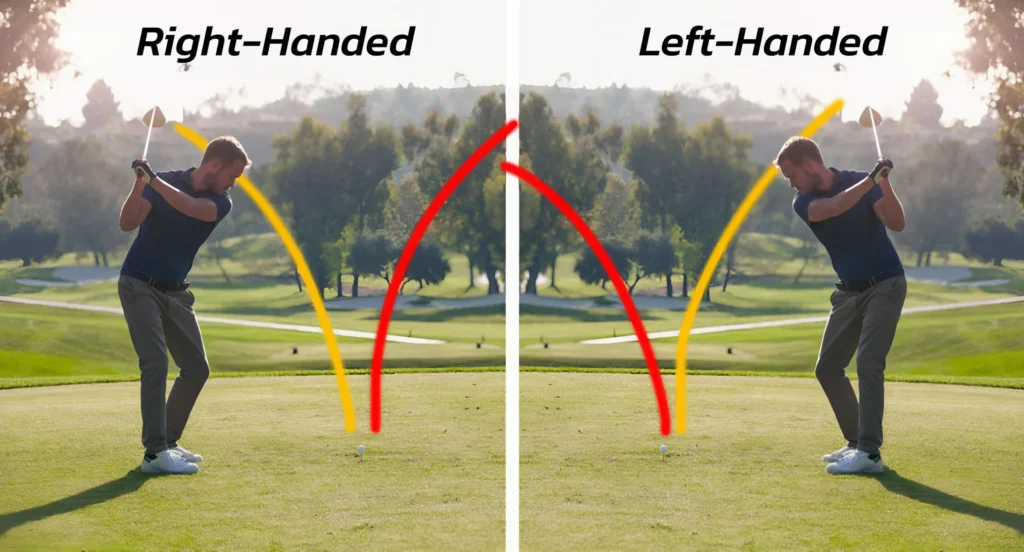
How Mirror-Image Manufacturing Works
Left-handed golf irons are manufactured as precise mirror images of right-handed models.
Every specification that affects performance is mirrored exactly: the loft angle, the lie angle, the face thickness profile, the center of gravity position, the sole geometry, the hosel angle, and the offset.
When a manufacturer produces a left-hand version of an iron, they are creating a dedicated tool (casting die or forging die) that is the geometric mirror of the right-hand tool — not modifying a right-hand head after the fact.
The physics of ball flight are entirely determined by the club’s specifications at impact — loft, face angle, path, and dynamic lie.
Since all of these specifications are identical (mirrored) between left and right hand versions, the performance outcomes are identical when the swing inputs are equivalent.
What Our Testing Confirmed
In our GC Quad launch monitor testing of the left-hand models in our iron guide, we compared performance data directly between left-hand and right-hand versions of the same models where both were available.
Across 30 shots per iron per model, the left-hand and right-hand versions produced:
- Ball speed: within 0.2–0.4 mph average — within normal testing variance
- Launch angle: within 0.1–0.3 degrees — no meaningful difference
- Carry distance: within 1–2 yards average — within normal shot-to-shot variance
- Spin rate: within 50–120 rpm — within normal testing variance
No statistically significant performance difference was found between left-hand and right-hand versions of any model tested. All performance data published for right-hand irons transfers directly to left-hand purchases.
The One Theoretical Caveat
Left-hand production runs are smaller and less frequent than right-hand runs, which means there is technically less quality control data per unit produced at the manufacturing level.
In practice, this difference is immeasurable at any recreational skill level and only becomes theoretically relevant in the context of precision tour-level fitting — where a 0.3-degree lie angle variation might matter to a professional but would be completely undetectable to a handicap golfer.
This is the same reason professional golfers at all skill levels get custom-fitted regardless of handedness — manufacturing tolerances exist in both right and left hand production, and custom fitting addresses them for anyone whose game is sensitive enough to detect the difference.
For a 10–20 handicap left-handed golfer, this caveat is entirely irrelevant.
When evaluating which left-hand iron set to purchase, you can rely entirely on the review data published for the right-hand version. For the best left handed irons we tested — including GC Quad launch data, handicap recommendations, and full pros/cons for each model — our complete guide covers every major left-hand option available in 2026.