Hybrid irons and regular irons are both designed to cover the same distance range in your golf bag, but they achieve that goal through fundamentally different engineering approaches. Understanding the actual performance differences — not just marketing language — allows you to make the right equipment decision for your game.
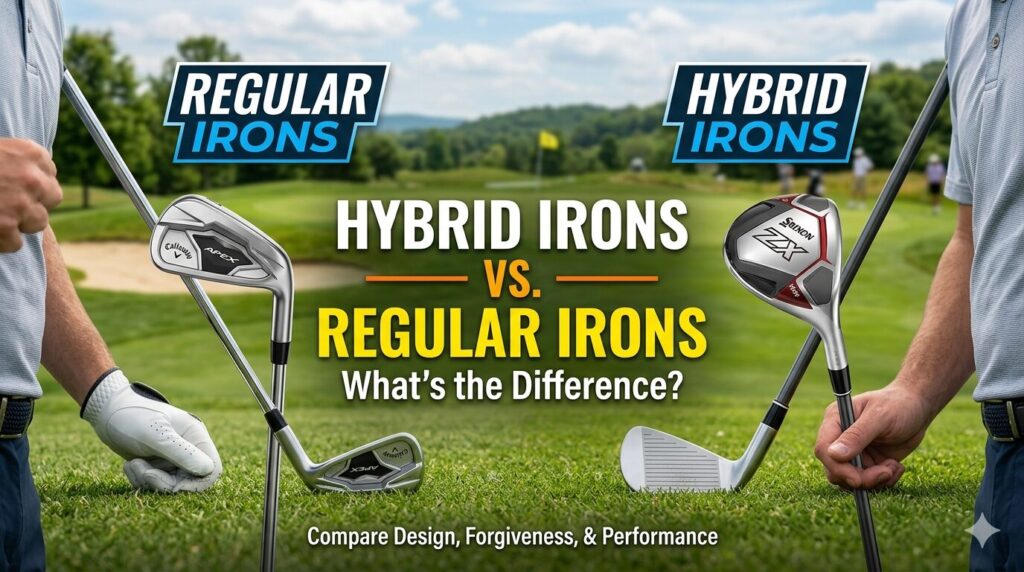
Construction Differences
Regular irons (cavity back game improvement irons) use cast or forged steel heads. The back of the clubface has material removed — the “cavity” — to move weight to the perimeter of the head.
This perimeter weighting increases the Moment of Inertia (MOI), reducing the degree to which off-center contact twists the face at impact.
Hybrid irons use hollow body construction — a thin steel face bonded to a hollow interior, similar to a fairway wood. The hollow interior allows engineers to position a much larger percentage of the club’s weight deep and low in the head, creating a lower and deeper CG than any cavity back design can achieve.
The thin face also generates a “trampoline effect” producing higher ball speed from a wider range of contact points.
Performance Differences
Launch Angle
Hybrid irons consistently launch the ball higher than regular irons of equivalent loft. The lower, deeper CG generates more vertical launch angle at impact without requiring a steeper angle of attack.
For golfers with swing speeds below 85mph, this translates to carrying the ball further because the launch angle is closer to the optimal window for slower swing speeds.
Forgiveness on Off-Center Contact
Both hybrid irons and modern game improvement irons are designed to be forgiving, but they achieve it differently.
A regular cavity back iron retains ball speed well across the face horizontally but loses significant ball speed on shots struck low on the face. Hybrid irons retain ball speed better across the entire face — including low contact — because the thin, flexible face generates ball speed across a larger area.
Rough and Lie Performance
Hybrid irons outperform regular irons significantly from rough lies.
The wide sole design with progressive cambering glides through rough rather than digging in — a performance difference that shows up meaningfully in the average score for golfers who miss fairways regularly.
Distance
Hybrid irons and regular game improvement irons produce similar distances when struck well by a golfer with sufficient swing speed.
The practical distance advantage of hybrid irons appears at swing speeds below 85mph, where the higher launch and better energy transfer from the flexible face generates more carry distance than the equivalent loft in a regular iron.
When to Choose Hybrid Irons
- Swing speed consistently below 85mph (7-iron speed)
- Handicap of 15 or above, particularly if long iron contact is inconsistent
- Senior golfer with declining swing speed
- Women golfer — lighter shafts and easier launch benefit most female swing tempos
- Beginner golfer wanting maximum forgiveness while learning
If any of those profiles match your game, the best hybrid iron sets we tested cover the top-performing options across each category with real launch monitor data.
When to Choose Regular Irons
- Swing speed consistently above 90mph
- Handicap of 12 or below with consistent iron contact across the set
- Prioritize feel and feedback over maximum forgiveness
- Prefer a traditional iron look at address