
Getting from a mid handicap to a low handicap — breaking into single digits — is the ambition of almost every serious golfer in the 10–18 range.
It’s also genuinely achievable for most dedicated players, but it requires a clear strategy that covers both your technique and your equipment.
This guide focuses specifically on the iron strategy side of that equation.
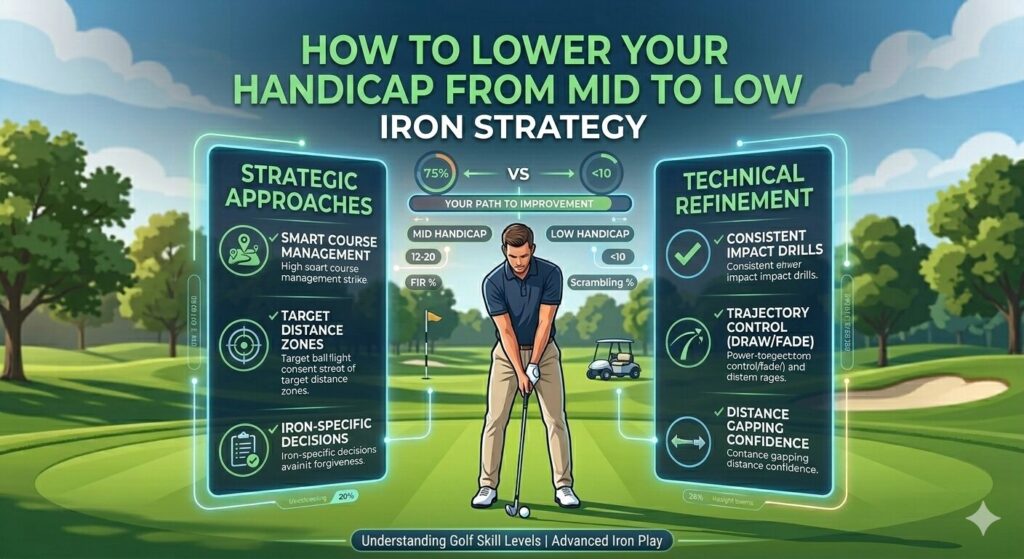
Why Irons Are the Decisive Factor in Moving From Mid to Low
Your driver, wedge game, and putting all matter. But irons are the shots that determine whether you give yourself birdie and par opportunities.
Every approach shot from 100–200 yards is an iron. Getting from 15 handicap to 9 handicap is fundamentally a story of improved iron play — more GIR, better distance control, tighter dispersion.
| Handicap | Avg GIR Per Round | Avg Putts Per Round | Key Improvement Area |
| 18–20 | 2–4 greens | 36–38 | Getting on green consistently |
| 14–17 | 4–6 greens | 33–36 | Distance control + direction |
| 10–13 | 6–9 greens | 31–34 | Hitting closer to pins |
| 7–10 | 9–12 greens | 30–32 | Consistent distance gaps + shot shaping |
| Scratch | 12–14 greens | 28–30 | Attacking pins under pressure |
Step 1: Audit Your Current Iron Performance
Before changing equipment, understand where your iron game is failing. For your next 5 rounds, track these metrics:
- GIR percentage — how often are you hitting the green from iron distance?
- Average distance from pin on GIR holes — are you on the green but 40 feet away?
- Miss direction — are you missing left, right, short, or long consistently?
- Strike quality — are your mishits heavy, thin, heel, or toe?
This data tells you whether your iron problem is distance control, direction, or strike quality — each has a different solution.
Step 2: Evaluate Whether Your Irons Are Holding You Back
Equipment becomes a genuine limiting factor in two specific situations for a mid handicapper transitioning to low handicap:
- Random distances: You’re consistently hitting GI irons but your distances are random — you have no reliable yardage for your 7-iron. A player’s distance iron with better feedback will help you develop consistent distance control.
- No shot shaping: You can’t shape shots when the course demands it. GI irons with high offset resist fade and draw. A player’s distance iron with minimal offset allows natural shot shaping.
Step 3: The Iron Upgrade That Accelerates Single-Digit Progress
For a 12 handicapper moving toward single digits, the most impactful iron upgrade is moving from a game improvement iron to a player’s distance iron.
Not blades — player’s distance. The TaylorMade P790 and Titleist T150 specifically combine the feedback and control you need to develop further with enough forgiveness that your score doesn’t collapse while you adjust.
Step 4: Close Your Distance Gaps
One of the most common score-killers for mid handicappers is inconsistent distance gaps between irons. If your 7-iron goes 145 and your 8-iron goes 140, you have a 5-yard gap where you have no club. Optimal gaps between irons are 10–15 yards per club.
A launch monitor session will identify your actual gaps — and often reveals that strong-lofted GI irons have created gap problems in the short irons.
Step 5: Get Properly Fitted
Every legitimate 10-handicap or better golfer has been fitted for their irons. Custom fitting typically adds 5–10 yards to every iron and tightens dispersion by 15–20%.
For a player moving from mid to low handicap, the gains from a professional fitting are directly measurable in scoring. We cover the full custom fitting question for mid handicappers in detail: our full mid handicapper iron recommendations — includes fitting guide