The game improvement vs player’s distance iron debate is the most important equipment decision a mid handicapper makes.
Get it right and your iron play genuinely improves. Get it wrong and you’re either fighting equipment that’s too demanding for your current skill level or playing forgiving irons that mask the feedback you need to improve further.
What Exactly Is a Game Improvement Iron?
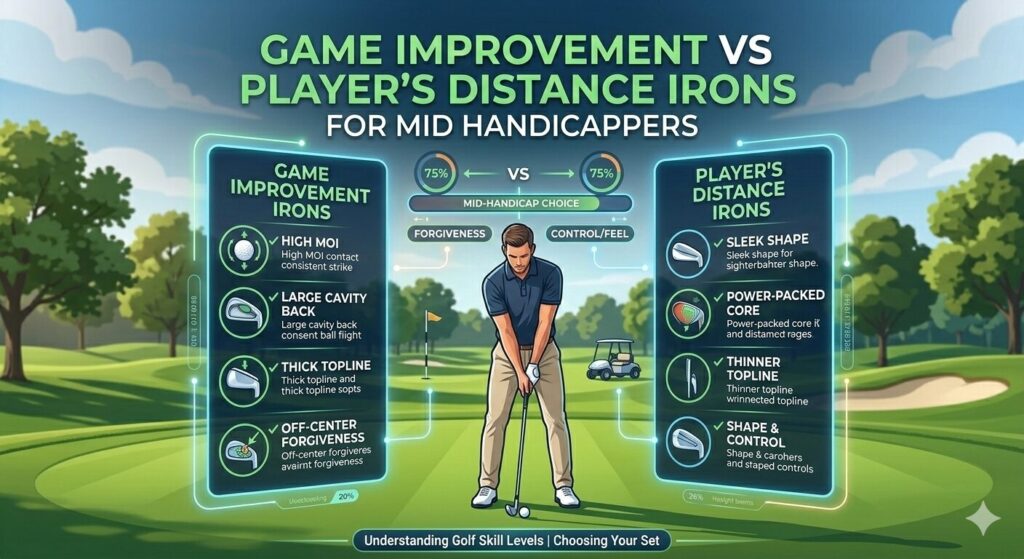
A game improvement (GI) iron is designed to maximize forgiveness, distance, and launch for golfers whose ball striking is still developing. The defining features are:
- Large, wide sole that reduces the consequence of fat contact
- Significant offset — the leading edge sits behind the shaft at address, which closes the face slightly and reduces slices
- Deep, wide cavity back that moves weight to the perimeter for maximum MOI
- Strong lofts (27–30° 7-iron) for more distance
- Hollow body construction in many modern versions for added ball speed
What Is a Player’s Distance Iron?
A player’s distance iron — the category occupied by clubs like the TaylorMade P790, Titleist T200, and Srixon ZXi5 — is the intelligent middle ground. It delivers:
- A more compact, tour-influenced head shape with a thinner topline
- Minimal offset — similar look to a player’s iron at address
- Hollow body or SpeedFoam construction for distance typically associated with GI irons
- Slightly stronger lofts than traditional player’s irons but not as aggressive as GI
- Better feel and feedback than GI irons while maintaining meaningful forgiveness
Not sure which category fits you? Find your personalised iron distances first.
The Full Comparison — Side by Side
| Factor | Game Improvement | Player’s Distance | Pure Player’s |
| Forgiveness (MOI) | Highest — 4,800+ g/cm² | High — 4,200–4,800 g/cm² | Lower — 3,400–4,000 g/cm² |
| Distance | Maximum (strong lofts) | Excellent (technology-driven) | Depends on ball striking |
| Feel / Feedback | Muted — forgiving | Balanced — informative | Maximum raw feedback |
| Offset | 5–7mm | 2–4mm | 0–2mm |
| Head Size | Large | Medium | Compact |
| Ideal Handicap | 14–28 | 8–18 | 0–10 |
| Best Brand Examples | Callaway Paradym Ai, Ping G440 | TaylorMade P790, Mizuno JPX925 | Titleist T100, Srixon ZXi7 |
The Decision Framework — Which Is Right for You?
Answer these questions honestly:
Q1: What is your current handicap?
Above 15 → Game Improvement. 10–15 → Player’s Distance. Below 10 → Player’s Distance or Pure Player’s.
Q2: How often do you chunk or thin irons?
More than twice per round → Game Improvement. Once or less → Player’s Distance is viable.
Q3: Is your main goal scoring lower or developing your ball striking?
Score lower → GI forgiveness helps. Develop striking → Player’s Distance feedback accelerates improvement.
Q4: Do you want to feel exactly where you made contact?
Yes → Player’s Distance. No → Game Improvement.
The Mid Handicapper’s Sweet Spot — The Player’s Distance Iron
For the majority of mid handicappers — handicaps between 10 and 18 — the player’s distance iron is the ideal choice. It was specifically designed for this transition phase.
It doesn’t forgive everything the way a GI iron does, but it doesn’t punish everything the way a blade does. It develops your game while protecting your score.
The specific irons that best represent this category for mid handicappers are analyzed in detail in our complete buying guide: our tested mid handicapper iron recommendations — game improvement to player’s distance picks