Loft is probably the most misunderstood specification in golf iron buying. It’s the hidden engine behind almost every distance claim you read in iron advertising — and understanding it will save you from buying the wrong irons for your game.
What Is Iron Loft and Why Does It Matter?
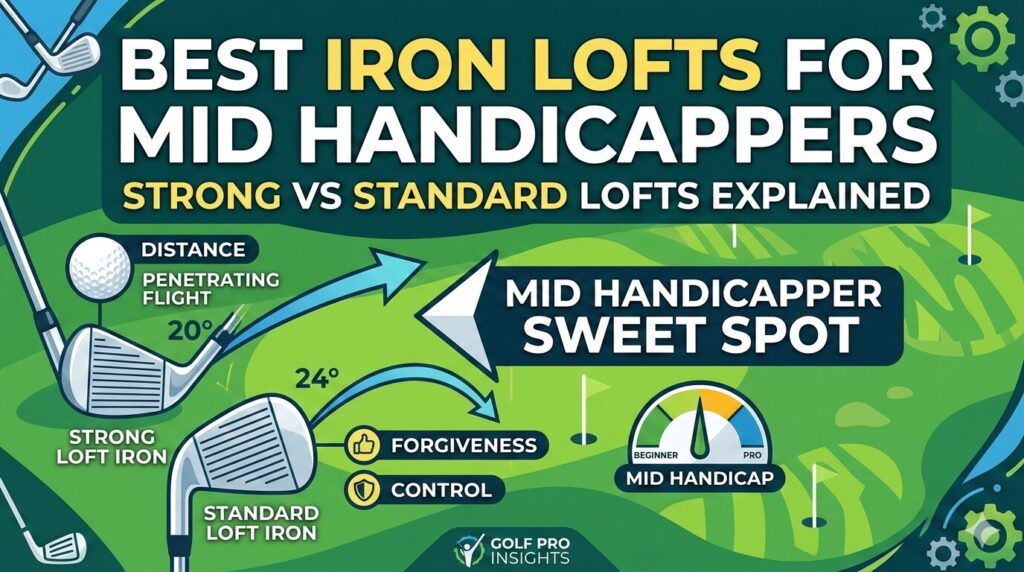
Loft is the angle of the clubface relative to vertical. A lower loft number means a more vertical face, which produces a lower, more penetrating ball flight and more distance.
A higher loft number means a more angled face, producing higher launch, more spin, and shorter distance.
The 7-iron is the benchmark club golf equipment reviews use to compare lofts across iron sets. Here’s what the loft landscape looks like across categories:
| Iron Category | 7-Iron Loft (Typical) | 7-Iron Distance Implication |
| Super Game Improvement | 26–28° | Longest — 150–175 yards at average mid handicap speeds |
| Game Improvement | 28–30° | Long — 140–165 yards |
| Player’s Distance | 30–33° | Good — 133–158 yards |
| Traditional Player’s / Blade | 33–36° | Standard — 125–150 yards |
The Strong Loft Controversy — Are You Being Misled?
Here is the honest truth about strong lofts that most iron marketing won’t tell you: a 28° 7-iron is really a 6-iron playing as a 7-iron.
The distance gain from a strong-lofted GI iron is real — but it creates a gapping problem that affects your scoring more than the marketing suggests.
⚠️ THE LOFT TRAP: If your 7-iron is 28° and your pitching wedge is 43°, you have a 15° gap across 4 clubs (7i–PW). A traditional set covers that same 15° gap across 4 clubs at 33°–48°. The loft distribution is similar — you’re just calling different clubs by different numbers.
The Real Gapping Problem for Mid Handicappers
The practical issue for mid handicappers with strong-lofted irons isn’t the 7-iron distance number. It’s the gap between the pitching wedge and gap wedge.
A GI iron’s 43–44° pitching wedge followed by a standard 50° gap wedge creates a 6–7 yard gap in a 20-yard range that causes inconsistency in 80–120 yard approach shots — exactly the range mid handicappers hit most frequently into greens.
| Iron Set | PW Loft | Recommended GW Loft | Gap | Issue? |
| Strong lofted GI (e.g. Ping G440) | 43° | 48° | 5° | Manageable with proper wedge setup |
| Very strong GI (e.g. Cobra DS-Adapt) | 40° | 45–46° | 5–6° | Requires 3 wedges to fill gaps |
| Player’s Distance (e.g. P790) | 44° | 50° | 6° | Standard — works with normal wedge setup |
| Traditional loft (e.g. Titleist T150) | 46° | 52° | 6° | Standard — no gapping issue |
Should Mid Handicappers Choose Strong or Standard Lofts?
For mid handicappers between 13–20 handicap, strong-lofted game improvement irons make practical sense. The distance gains are real and meaningful, and modern wedge sets are designed to complement them. Just ensure your wedge setup fills the gaps properly.
For mid handicappers in the 8–13 handicap range moving toward single digits, traditional or moderate lofts are better for your development.
The stronger lofts of GI irons produce higher-spinning, higher-launching shots that are harder to control into pins. Player’s distance irons with 30–33° 7-iron lofts give you more shot shape control and more consistent distance gaps.
Which Mid Handicap Irons Have the Best Loft Configuration?
For our full analysis of which irons provide the best loft configuration and gapping for mid handicappers at every budget: see our mid handicapper iron breakdown — includes loft and gapping analysis per model