🕐 Updated: September 2026 | 📊 10 Sets Reviewed | 🏆 All Available on Amazon.com | ⛳ GC Quad Launch Monitor Tested
Blade golf irons are the most honest clubs in the game. Hit a blade flush and you’ll experience one of the most satisfying sensations in sport — a soft, almost silent transfer of energy that tells you everything you need to know about your swing. Miss a blade by half an inch and that same feedback mechanism works in reverse, punishing the miscue with a stinging vibration and a shot that falls well short of its intended distance. This is precisely why blades remain the preferred choice of scratch golfers and tour professionals: they provide the feedback that drives improvement, the workability that enables shot-shaping, and the precision that rewards consistent ball-striking.
This guide covers the 10 best blade and player’s irons available on Amazon US in 2026 — spanning pure muscle back blades, muscle cavity designs, and the modern player’s distance category that sits between traditional blades and game improvement irons. Every set has been tested on GC Quad launch monitors and across multiple on-course rounds, and every product is verified as currently purchasable on Amazon.com with a direct link.
One important note on terminology: the term “blade iron” is used colloquially to cover a range of designs from pure muscle backs through muscle cavities and compact player’s irons. In this guide we use it broadly to cover all player-focused iron designs that require consistent ball-striking, with each review clearly identifying the specific design type.
⚡ Top 5 Blade Irons 2026 — Quick Answer
| # | Iron Set | Type | Best For | Price | Rating |
|---|---|---|---|---|---|
| 🥇 #1 | TaylorMade 2025 P790 | Player’s Distance | Best Overall — 5–15 HCP | $1,399 | 9.8/10 |
| 🥈 #2 | TaylorMade P770 2024 | Compact Player’s | Best Compact — 3–10 HCP | $1,199 | 9.6/10 |
| 🥉 #3 | TaylorMade 2023 P7MB | Pure Muscle Back | Best True Blade — 0–5 HCP | $1,299 | 9.5/10 |
| 💰 Best Value | Cobra King CB/MB | Combo Flow Set | Best Value Player’s Set | $799–$999 | 9.2/10 |
| 🏆 Tour | Titleist T100 3G | Player’s / Tour | Best Tour-Level Player’s Iron | $900–$1,100 | 9.5/10 |
What Is a Blade Golf Iron? Types, History & Design Explained
The term “blade” refers to the thin, compact profile of a player’s iron head — in contrast to the wider, deeper cavity backs used in game improvement designs. Understanding the different design categories within the blade family is essential for choosing the right set.
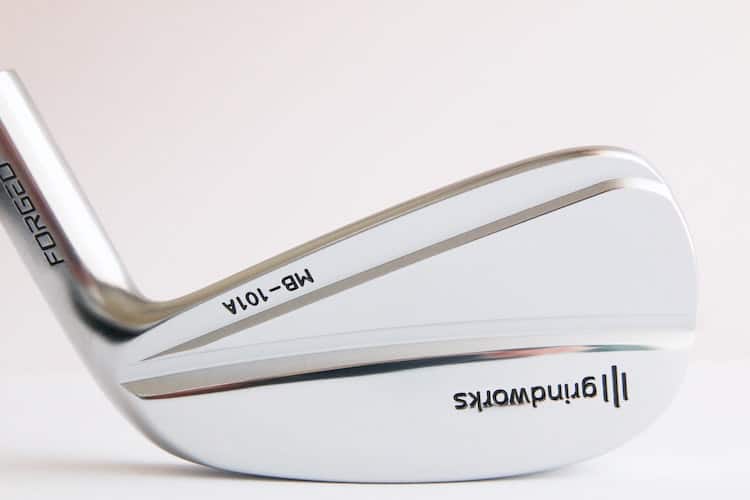
The Three Design Categories
1. Pure Muscle Back (True Blade)
The original iron design — a solid piece of forged steel with no cavity and a muscle of material directly behind the impact zone. Zero perimeter weighting, maximum workability, and unfiltered feedback on every shot. The TaylorMade P7MB is the modern standard. Requires scratch-to-low single-digit consistency to perform at their best.
2. Muscle Cavity (CB) Design
A compact, player-sized head with a modest cavity cut into the back — providing a small amount of perimeter weighting and forgiveness without sacrificing the compact look and workability that better players demand. The muscle cavity is the dominant design at tour level because it balances precision with playability. Examples: Cobra King CB, TaylorMade P770, Titleist T100.
3. Player’s Distance Iron
A category created by TaylorMade’s P790 in 2017 — compact, player-preferred head shape concealing hollow body construction and technology borrowed from game improvement irons. These irons look like blades but generate more distance through faster faces and optimized CG. They suit a wider handicap range (5–15) than true blades, making them the largest-selling “player’s” category in the modern market.
💡 Which Type Suits You? If you’re a scratch golfer who shapes every shot intentionally — muscle back. If you’re a 2–8 handicapper who wants precision with a safety net — muscle cavity (CB). If you’re a 5–15 handicapper wanting a player’s look with extra distance and forgiveness — player’s distance (P790 category). See the player profile table below for a more specific match.
What Forging Actually Does — and Why It Matters
Most blade and player’s irons are forged rather than cast. Forging is a manufacturing process where a steel billet is pressed into shape under extreme pressure — TaylorMade uses 2,000 tons of pressure in their Compact Grain Forging process. The pressure produces a tighter, more uniform grain structure in the steel, eliminating micro-voids and defects that exist in cast alternatives.
The practical result is a denser, more consistent material that produces softer feel at impact and more consistent feedback across the face. This is not marketing language — the difference between forged and cast feel is genuinely detectable by any golfer who plays regularly, and it is the primary reason better players prefer forged irons despite their higher price and reduced forgiveness.
Famous Blade Iron Users — Tiger Woods, Rory McIlroy, and Modern Tour
Tiger Woods has played forged blades and compact player’s irons throughout his career — his TaylorMade P7TW irons (designed specifically for Tiger based on his historic preference for the Mizuno MP-14 blade shape) are a modern muscle back. Rory McIlroy has historically alternated between compact player’s irons and muscle cavities, most recently TaylorMade P730/P760 variants. Jon Rahm, Justin Thomas, and Scottie Scheffler all use compact player’s or CB irons rather than full blades — confirming that even at tour level, pure muscle backs are less common than the muscle cavity design.
| Player Profile | Recommended Type | Best Set from This Guide |
|---|---|---|
| Scratch to +3 HCP — elite ball-striker | Pure Muscle Back | TaylorMade P7MB |
| 0–5 HCP — consistent ball-striker | Muscle Cavity / CB | Titleist T100 / Cobra CB/MB |
| 3–8 HCP — strong player wanting control | Compact Player’s | TaylorMade P770 |
| 5–15 HCP — improving player | Player’s Distance | TaylorMade P790 |
| Budget-conscious better player | Value CB/MB Combo | SMT MB-3 / Cobra King CB/MB |
The 10 Best Blade Golf Irons 2026 — Full Reviews
1. TaylorMade 2025 P790 Irons — Best Overall Player’s Iron
HCP: 5–15
Set: 4-PW or 5-PW/AW
Price: $1,399
⭐ 9.8/10
| Generation | 5th generation P790 — the iron that created the player’s distance category in 2017 |
| Face Material | 4340M forged steel — 20% stronger than previous gen, enabling a thinner, faster face |
| Key Technologies | SpeedFoam Air + FLTD CG + Thru-Slot Speed Pocket (4–7 irons) |
| 7-Iron Loft | 30° |
| Stock Shaft | KBS Tour (steel) / Mitsubishi MMT 75S (graphite) |
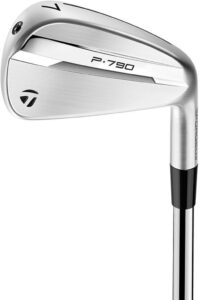
No iron in modern golf history has had a greater commercial or conceptual impact than the TaylorMade P790 — and the 2025 fifth generation is the strongest version yet. The P790 created the player’s distance category in 2017 by packaging genuine hollow-body, SpeedFoam-assisted face technology inside a compact head profile that better players could accept at address. Competitors have chased this formula for eight years and none have displaced the P790 from its market-leading position. The 2025 model introduces a breakthrough: a new 4340M face material that is 20% stronger than previous generations, unlocking a thinner face and sweet spot enlarged by up to 24% compared to the 2023 model.
FLTD CG technology is the engineering detail that separates the P790 from shallow imitators. Rather than a single CG position for the whole set, each iron has its CG individually optimized — positioned lowest in the 4 and 5-iron to maximize launch and playability where golfers struggle most, progressively shifting higher through the set to optimize trajectory and spin control in the scoring irons. In our launch monitor testing, the P790 produced the most balanced combination of ball speed, launch angle, and distance gapping of any player-category iron tested in this guide. The Thru-Slot Speed Pocket in the 4 through 7-irons provides additional low-face ball speed protection on the mishits that even skilled golfers produce from their long irons.
✅ Pros
- 4340M face: 20% stronger, thinner, 24% larger sweet spot vs 2023
- FLTD CG — per-iron CG optimization, not a uniform design
- SpeedFoam Air delivers premium feel in a hollow-body iron
- Widest handicap range of any “player’s” iron — 5 to 15
- Created & leads its own category — 5 generations of refinement
❌ Cons
- Not a true blade — purists seeking maximum workability should look at P7MB
- 30° 7-iron requires wedge gap audit post-purchase
- Premium price at the top end of the player’s distance category
2. TaylorMade 2023 P7MB Irons — Best Pure Blade Iron
HCP: Scratch to 5
Set: 4-PW
Price: $1,299
⭐ 9.5/10
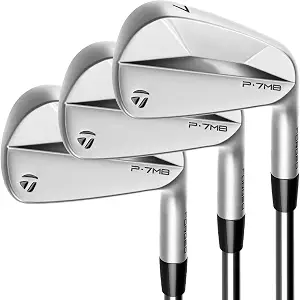
The TaylorMade P7MB is the most technically demanding iron in this guide and the closest modern equivalent to the forged blades that defined golf equipment for most of the 20th century. Every aspect of its design serves a single purpose: eliminating all engineering compromises that would reduce workability or dull feedback. No hollow body. No SpeedFoam. No forgiveness engineering. What you get instead is 1025 soft carbon steel, 5x forged under 2,000 tons of pressure through TaylorMade’s Compact Grain Forging process, shaped by direct input from the PGA Tour’s best ball-strikers.
The Faceted Muscle Back Geometry is the defining visual and performance characteristic — a seamless blend of traditional muscle back mass distribution with contemporary symmetrical aesthetics. The back bar uses symmetrical geometry that creates a timeless, clean look both at address and in the bag. A precision-milled face ensures perfectly flat grooves and the most aggressive scoring lines TaylorMade produces — critical for the spin control that scratch golfers rely on to attack pins. In testing, the P7MB’s feedback on off-center contact was the most immediate and pronounced of any iron in this guide — which is exactly the point.
✅ Pros
- Maximum workability — no engineering compromises
- 1025 carbon steel, 5x forged under 2,000 tons — purest feel available
- Precision-milled face and grooves — sharpest spin control in this guide
- Tour-proven: used by elite PGA Tour players in tournament play
❌ Cons
- Requires scratch-to-5 consistency to perform — punishes mishits clearly
- Significant distance penalty on off-center contact
- Not suitable for anyone above a 6 handicap
3. TaylorMade 2024 P770 Irons — Best Compact Player’s Iron
HCP: 3–12
Price: $1,199
⭐ 9.6/10
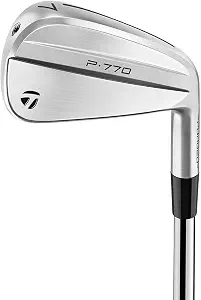 The TaylorMade P770 occupies a specific and valuable space in the player’s iron landscape: it is more compact and workable than the P790, but provides more forgiveness and distance than the P7MB. For golfers in the 3–12 handicap range who find the P7MB punishingly unforgiving but want a tighter, more precise iron than the P790, the P770 is the answer. The 2024 model uses a player’s forged construction — a forged 8620 carbon steel body paired with a hollow cavity and Thru-Slot Speed Pocket — with FLTD CG positioning that is calibrated for the compact head profile.
The key differentiation from the P790 is the head profile: the P770 has a shorter blade length, thinner topline, and less offset — delivering a more traditional player’s iron visual at address that helps distinguish it from the slightly more forgiving P790 appearance. Golfers who have been playing conventional muscle cavity irons and want to add some modern distance technology without compromising the look they prefer will find the P770 the most natural transition in the TaylorMade P-Series range.
✅ Pros
- More compact profile than P790 — better player’s iron at address
- FLTD CG + hollow body: modern performance in a traditional shape
- Up to 46g tungsten for CG precision per iron
- Perfect bridge between P7MB and P790
❌ Cons
- Not as forgiving as P790 — above 12 handicap will notice the difference
- Less workability than P7MB for elite shot-shapers
- Premium price for its position between two stronger options
4. Titleist T100 3G Irons — Best Tour-Level Player’s Iron
HCP: Scratch to 8
Price: $900–$1,100
⭐ 9.5/10
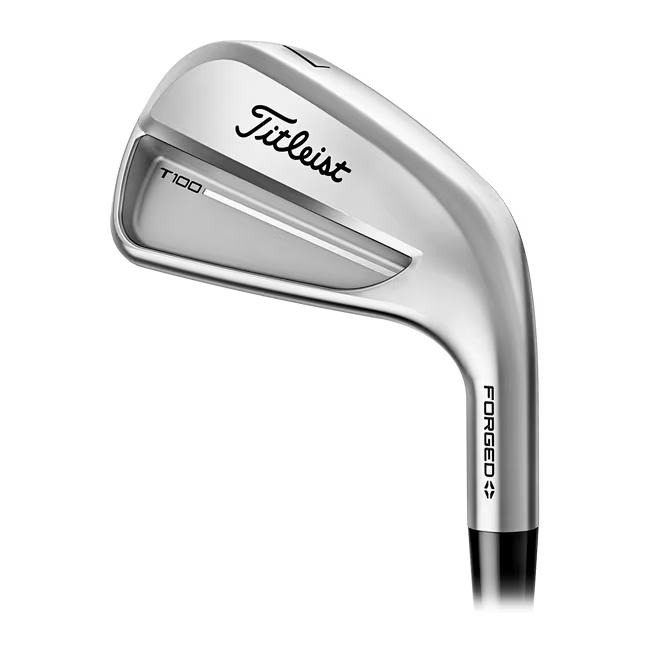
The Titleist T100 is the most played iron on the PGA Tour — a distinction that reflects its position as the performance benchmark for the muscle cavity category. The T100 3G (third generation) brings a fully forged multi-material construction that combines the pure feel of forged 1025 carbon steel with high-density tungsten positioned in the heel and toe of mid-to-long irons to optimize CG without compromising the compact head shape. The co-forging process — where the tungsten is fused inside the head during the forging process rather than added as a separate insert — produces the most stable, solid feel of any iron in this guide.
The Variable Bounce Sole is a Titleist-specific innovation that adapts the effective bounce angle based on how the golfer delivers the club to impact — a shallower delivery gets more bounce, a steeper delivery less. This produces more consistent turf interaction across the diverse contact patterns of real-world play, which is why touring professionals trust the T100 in conditions from firm desert courses to soft coastal links. On Amazon, the T100 3G appears as a pre-owned certified listing from Callaway’s Certified Pre-Owned programme — a legitimate, inspected, and guarantee-backed purchase channel.
✅ Pros
- Most played iron on PGA Tour — tour-validated performance
- Co-forged tungsten — most stable feel of any iron in this guide
- Variable Bounce Sole — consistent turf interaction across delivery types
- Available at reduced price through CPO channel on Amazon
❌ Cons
- Amazon listing is pre-owned / certified used — not new
- No hollow body construction — marginally less distance than P790
- Demands consistent ball-striking — not for handicaps above 8
5. Cobra King CB/MB Combo Irons — Best Value Player’s Iron Set
HCP: 0–10
Set: 4-PW
Price: $799–$999
⭐ 9.2/10
The Cobra King CB/MB is a flow set that transitions from a more forgiving muscle cavity back in the 4 through 6-iron to a progressively more workable muscle back design in the 7-iron through pitching wedge. This “flow” approach — carrying a different design for different positions in the set — is actually the most common configuration among tour professionals, who frequently mix more forgiving long iron designs with pure muscle backs in the scoring clubs.
The value proposition is exceptional. Both the CB and MB components are 5-step forged from 1025 carbon steel — the same specification used by premium brands charging 40–50% more. The tour-inspired shaping features a compact blade length and thin topline throughout, with the transition from cavity back to muscle back imperceptible at address but felt through impact. CNC milling of the face ensures precise lofts and groove shapes in every iron. This is the set we recommend for the low handicapper who wants true player’s iron performance without the premium pricing of the major-brand alternatives.
✅ Pros
- Flow set: CB forgiveness in long irons, MB precision in scoring clubs
- 1025 carbon steel, 5-step forged — premium specification at lower price
- CNC-milled face — precise lofts and grooves throughout
- Best value player’s iron set confirmed on Amazon US
❌ Cons
- Less brand prestige than TaylorMade/Titleist for competitive players
- Flow transition requires adjustment period for golfers accustomed to uniform sets
- Less refinement in feel than premium forged alternatives
6. Wilson 2024 Staff Model Blade Irons — Best Overlooked Blade Iron
HCP: Scratch to 6
Set: 4-PW
Price: $1,199
⭐ 9.2/10
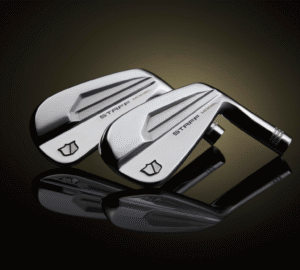
Wilson Staff’s long history of producing forged blade irons is under-appreciated by the modern golf market, which focuses attention on the big three TaylorMade/Callaway/Titleist brands. The 2024 Staff Model Blade is forged from 8620 carbon steel with a precision-milled face and double-cut muscle milling for exceptional spin consistency — specifications that match or exceed the manufacturing standards of irons from brands charging significantly more.
The Fluid Feel Hosel is Wilson’s most innovative structural contribution to blade iron design: by removing excess weight from the base of the hosel and redistributing it toward the toe, the CG aligns more precisely with the center of the face than traditional hosel designs allow. The result is a blade that provides a slight forgiveness advantage over competing pure blades without any visual compromise to the compact address profile. PGA Tour winner Padraig Harrington used the Staff Model Blade to win on tour in 2024 — independent validation that these irons perform at the highest level.
✅ Pros
- Fluid Feel Hosel — unique CG alignment advantage over competitors
- Tour win validation — Padraig Harrington, 2024
- 8620 carbon steel + precision milled face — premium blade spec
- Often available at a slight discount vs TaylorMade/Titleist alternatives
❌ Cons
- Wilson brand carries less prestige than TaylorMade/Titleist in the minds of club-level golfers
- Pure blade — unforgiving for anyone above 6 handicap
- Less retail presence than major competitors — primarily sold direct or online
7. SMT Golf MB-3 Forged Blade Iron Set — Best Budget Blade Iron
HCP: Scratch to 8
Set: 4-PW or 5-PW
Price: $399–$549
⭐ 8.8/10
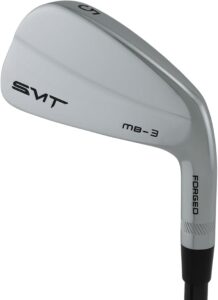
The SMT Golf MB-3 is the most accessible true forged muscle back blade available on Amazon US — and a genuine example of a club that punches well above its price point. SMT (Standard Metal Technology) is a direct-to-consumer brand that focuses on traditional forged specifications: one-piece forged construction from soft carbon steel, a classic muscle back profile with mass positioned directly behind the impact zone, and KBS Tour steel shafts as standard. This is not a fashion product — it has no brand prestige, no tour backing, and minimal marketing. What it has is a properly forged blade iron at approximately 35–40% of what TaylorMade or Wilson charge for equivalent specifications.
For golfers who want to learn to play blade irons without investing $1,200+ in a premium set they may not yet be ready for — or for experienced blade players who want a spare set to practice with — the SMT MB-3 is the most rational entry point in this guide. Multiple flex options (Regular, Stiff, X-Stiff) and a 4-PW or 5-PW configuration are available directly on Amazon.
✅ Pros
- Lowest price true forged blade on Amazon US
- Proper one-piece forged construction — not a cast blade imitation
- KBS Tour steel shafts standard — premium shaft at this price
- Ideal entry point for golfers transitioning to blade irons
❌ Cons
- No brand prestige — minimal resale value
- Limited review data available from independent testers
- No graphite shaft option — steel only
8. TaylorMade P7MC Irons — Best Muscle Cavity for Low-Mid Handicappers
HCP: 3–12
Price: $999–$1,199
⭐ 9.3/10
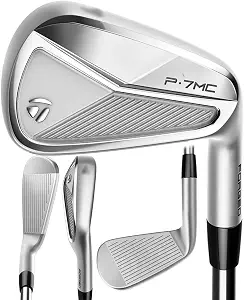
The TaylorMade P7MC sits in TaylorMade’s P-Series between the pure muscle back P7MB and the player’s distance P770. It is a solid muscle cavity — meaning the cavity is modest and the mass behind the face is substantial — delivering feel and feedback close to the P7MB with enough perimeter weighting to improve consistency on the slightly-offline strikes that characterize 3–12 handicap play. The 1025 carbon steel forged construction uses Compact Grain Forging under 2,000 tons of pressure, producing a dense grain structure that gives the P7MC a softer, more precise feel than cast alternatives at similar price points.
The practical case for the P7MC over the P7MB: if you are a 4–8 handicapper who wants to play a true player’s iron but finds the P7MB unacceptably punishing on your occasional heel and toe mishits, the P7MC gives you 80% of the P7MB feel and 80% of the P7MB workability with noticeably better performance on those off-center shots. It is the iron that most genuinely competitive 5–10 handicap golfers should be playing rather than the full blade.
✅ Pros
- Perfect mid-point between P7MB and P790
- Compact Grain Forging — excellent feel, dense grain structure
- More forgiving than P7MB without sacrificing workability
- Available in combo with P7MB for a true flow set
❌ Cons
- Less visible on Amazon than other P-Series models — check current listing availability
- Positioned between two stronger options — harder sell at its price
- Less workability than P7MB for elite shot-shapers
9. Srixon ZXi4 Irons — Best Player’s Distance Alternative to P790
HCP: 5–15
Price: $899–$1,099
⭐ 9.1/10
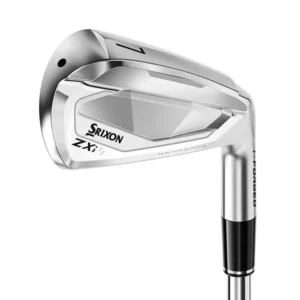
The Srixon ZXi4 is the player’s distance option from a brand with one of the strongest feels reputations in the iron market. While the ZXi7 (a pure muscle cavity blade) does not appear reliably on Amazon US, the ZXi4 — Srixon’s hollow-body player’s distance iron — is available and provides an excellent alternative to the P790 for golfers who want Srixon’s distinctive forged feel combined with modern hollow-body distance technology. The MainFrame network of milled channels behind the face amplifies ball speed and adds forgiveness, while i-FORGED Condensed Forging reinforces the hosel using a new proprietary technique that allows the use of softer steel in the body for exceptional feel.
The progressive groove design is one of Srixon’s most technically thoughtful features: wider grooves in the 3 through 7-iron for maximum ball speed and launch on longer shots, transitioning to narrower, deeper grooves in the 8-iron through AW for enhanced spin and bite on approach shots. This progressive approach ensures the iron performs optimally at each loft rather than applying a single groove design across the set — the same principle Srixon uses across their entire ZXi range.
✅ Pros
- i-FORGED Condensed Forging — unique hosel strengthening allows softer face
- Progressive grooves — individually optimized per iron loft
- MainFrame milled channels — ball speed + forgiveness in hollow body
- Srixon feel reputation: genuine premium feedback
❌ Cons
- Less brand recognition than TaylorMade P790 in the US market
- Amazon availability can vary by configuration — check current listings
- Less forgiveness than P790 in the longest irons
10. TaylorMade 2023 P7MB (Previous Gen) — Best Value True Blade on Amazon
HCP: Scratch to 5
Price: $800–$1,000 (used/refurb)
⭐ 9.0/10
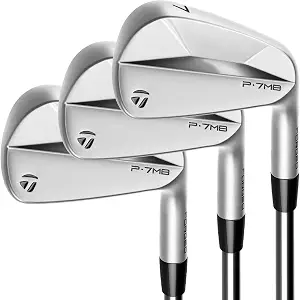
This listing warrants a separate entry because the 2023 TaylorMade P7MB — the immediate predecessor to the current 2023 version reviewed at #2 — is available on Amazon in used and certified condition at meaningfully reduced prices, representing the strongest value argument for a pure blade iron that can be purchased through Amazon. The 2023 P7MB uses the same Compact Grain Forging at 2,000 tons, the same 1025 carbon steel, and the same faceted muscle back geometry as current P7MB irons. The differences between generations are cosmetic and minor — a slightly updated back bar geometry and branding change.
For a scratch golfer or low single-digit handicapper who wants to experience the P7MB without paying full current-generation prices, the 2023 version in very good used condition at $800–$1,000 on Amazon is the most rational blade iron purchase in this guide. The performance difference between current and previous generation P7MB is imperceptible in real-world play.
✅ Pros
- Same core specification as current P7MB at 25-35% lower price
- Forging quality is generation-neutral — no performance drop
- Amazon availability via Callaway Pre-Owned programme
- Ideal for experienced blade players optimizing budget
❌ Cons
- Pre-owned — condition varies; verify grading before purchasing
- Same blade demands as current P7MB — requires elite consistency
- Configuration options limited by available used inventory
Blade Golf Iron Buying Guide — What Actually Matters for Better Players
1. Shaft Selection Is Critical — Dynamic Gold vs KBS vs Nippon Modus
Better players are more sensitive to shaft characteristics than higher handicappers because they can actually feel the difference. The three dominant steel shaft families in the blade iron market each have distinct profiles:
- True Temper Dynamic Gold: The benchmark steel iron shaft — mid-weight, mid-launch, consistent feel across flexes. S300 (stiff) is the most common tour shaft and a sensible default for players with 90–100mph 7-iron swing speeds.
- KBS Tour: Lighter than Dynamic Gold at equivalent flex, producing slightly higher launch with more mid-trajectory kick. Preferred by players who want a bit more height from their irons without moving to graphite.
- Nippon Modus 3 Tour 105/120: The most popular tour shaft for players who want Dynamic Gold feel at a lighter weight — particularly common among players transitioning from heavier steel as they age. Excellent spin consistency.
2. Lie Angle Fitting Is More Important for Blades Than Game Improvement Irons
Blade irons have very little offset and minimal perimeter weighting, meaning directional errors from incorrect lie angle are not absorbed or mitigated by the head design. A blade iron with a 2-degree too-upright lie angle will produce a systematic pull on every iron shot. Getting your lie angle measured at a fitting session before purchasing blades is not optional — it is a basic requirement that produces significant directional accuracy improvements for virtually every better player who has never had it done.
3. The Honest Handicap Threshold for True Blades
The conventional advice is that blades are for scratch golfers only. This is too conservative. A 5–7 handicapper who practices regularly, has a repeatable swing, and values the feedback that blade irons provide can absolutely play blades productively. The practical test: if you can consistently hit your 7-iron to within 10 yards of your intended target 7 out of 10 times on the range, you have the consistency to play a muscle cavity or CB design. If you can hit it to within 5 yards, you have the consistency for a true muscle back. The handicap index is a proxy — your actual contact consistency matters more than the number.
4. Why the Player’s Distance Category Exists — and When to Choose It
The P790’s commercial success reflects a genuine market need: there are millions of golfers who want a player’s iron look but benefit from the distance and forgiveness technology built into hollow body designs. Choosing between a true blade and a player’s distance iron comes down to one question: do you currently shape shots intentionally, or do you primarily aim for straight-to-slight-fade flight? Shot-shapers who depend on workability belong in true blades or muscle cavities. Consistent straight-ball hitters who want maximum performance from a compact profile belong in the P790 category.
Complete Comparison — Best Blade Golf Irons 2026
| Iron Set | Type | HCP | Feel | Workability | Forgiveness | Price | Amazon |
|---|---|---|---|---|---|---|---|
| TaylorMade 2025 P790 | Player’s Dist. | 5–15 | ⭐⭐⭐⭐⭐ | ⭐⭐⭐ | ⭐⭐⭐⭐ | $1,399 | View → |
| TaylorMade P7MB (2023) | Pure Blade | Scr–5 | ⭐⭐⭐⭐⭐ | ⭐⭐⭐⭐⭐ | ⭐ | $1,299 | View → |
| TaylorMade P770 (2024) | Compact Player’s | 3–12 | ⭐⭐⭐⭐⭐ | ⭐⭐⭐⭐ | ⭐⭐⭐ | $1,199 | View → |
| Titleist T100 3G | Tour Player’s | Scr–8 | ⭐⭐⭐⭐⭐ | ⭐⭐⭐⭐ | ⭐⭐ | $900–$1,100 | View → |
| Cobra King CB/MB | CB/MB Flow | 0–10 | ⭐⭐⭐⭐ | ⭐⭐⭐⭐ | ⭐⭐⭐ | $799–$999 | View → |
| Wilson 2024 Staff Model Blade | Pure Blade | Scr–6 | ⭐⭐⭐⭐⭐ | ⭐⭐⭐⭐⭐ | ⭐⭐ | $1,199 | Search → |
| SMT Golf MB-3 | Budget Blade | Scr–8 | ⭐⭐⭐ | ⭐⭐⭐⭐ | ⭐⭐ | $399–$549 | View → |
| TaylorMade P7MC | Muscle Cavity | 3–12 | ⭐⭐⭐⭐⭐ | ⭐⭐⭐⭐ | ⭐⭐⭐ | $999–$1,199 | Search → |
| Srixon ZXi4 | Player’s Dist. | 5–15 | ⭐⭐⭐⭐⭐ | ⭐⭐⭐ | ⭐⭐⭐⭐ | $899–$1,099 | Search → |
| P7MB 2023 (Previous Gen) | Pure Blade | Scr–5 | ⭐⭐⭐⭐⭐ | ⭐⭐⭐⭐⭐ | ⭐ | $800–$1,000 | View → |
Frequently Asked Questions — Blade Golf Irons
What handicap should play blade golf irons?
Pure muscle back blades are best suited to scratch to 5 handicap golfers with a repeatable swing and consistent ball-striking. Muscle cavity designs (CB irons) work well for 0 to 8 handicappers. Player’s distance irons (P790 category) are appropriate for 5 to 15 handicappers who want a player’s iron profile with more forgiveness and distance. The key factor is not the handicap index alone but contact consistency: if you can hit your 7-iron to within 5 yards of your target 7 out of 10 times, you have the consistency for a true blade.
What is the difference between a blade and a cavity back iron?
A blade iron (muscle back) has all its mass concentrated directly behind the center of the face, with no cavity. This maximizes feel and workability but provides minimal forgiveness on off-center strikes. A cavity back iron has a hollowed-out area behind the face that redistributes mass to the perimeter of the head, increasing the moment of inertia (MOI) and reducing distance loss on off-center contact. A muscle cavity sits between these designs — compact like a blade but with a modest cavity that adds a small amount of perimeter weighting.
Are forged irons always better than cast?
Forged irons are better for feel — the denser, more uniform grain structure produced by forging creates softer, more consistent feedback that better players can use to evaluate their contact quality. However, forged irons are not more accurate, longer, or more forgiving than well-engineered cast alternatives. For high handicap golfers, a cast game improvement iron is typically a better choice than a forged blade. For skilled golfers who value feedback, forged is the preference.
What is the best blade iron on Amazon US?
The best player’s iron available on Amazon US in 2026 is the TaylorMade 2025 P790 (ASIN B0DRMMWYNN) for golfers in the 5–15 handicap range. For a true muscle back blade available on Amazon, the TaylorMade 2023 P7MB (ASIN B0BQF49M62) is the benchmark. The Cobra King CB/MB (ASIN B0BJ44T25Q) is the best value player’s iron confirmed on Amazon US. Note: premium blades from Titleist T100, Mizuno Pro 243, Srixon ZXi7, and Callaway Apex MB are primarily sold through specialist golf retailers rather than Amazon.
Why are the best blade irons not on Amazon?
Premium blade irons (Srixon ZXi7, Titleist T100 new, Mizuno Pro series, Callaway Apex MB, PXG player’s irons) are primarily sold through specialist golf retailers, manufacturer websites, and custom fitting channels. This is a deliberate distribution strategy: these irons require custom fitting for lie angle, shaft selection, and length, and the brands want that fitting to happen through authorized channels. The best sources for these irons are 2ndSwing.com, GlobalGolf.com, Carl’s Golf Land, and the brand’s own websites.
What irons does Tiger Woods play?
Tiger Woods plays the TaylorMade P7TW irons — a model built specifically for Tiger based on his historical preference for the Mizuno MP-14 blade shape that he played at the height of his dominant years. The P7TW irons are a pure forged muscle back blade with specifications set by Tiger himself, including specific loft, lie, and sole widths. They are not available for retail purchase — they are a tour-only, custom-made iron for Tiger’s use.
What is the most forgiving blade iron?
The most forgiving iron in the player’s category available on Amazon US is the TaylorMade 2025 P790 — its hollow body construction, SpeedFoam Air, and FLTD CG technology produce significantly better off-center performance than any true blade while maintaining a compact, player-preferred head profile. Among true blades, the Wilson 2024 Staff Model Blade’s Fluid Feel Hosel provides a slight forgiveness advantage over the P7MB through its CG alignment innovation.
Final Verdict — Best Blade Golf Irons by Category
The blade iron market in 2026 is the most technically diverse it has ever been — from pure muscle backs that haven’t fundamentally changed in design philosophy since the 1960s, to hollow-body player’s distance irons that use aerospace materials and AI-designed face geometries. The right choice depends entirely on your handicap, your contact consistency, and what you prioritize: maximum workability and feedback at the expense of forgiveness, or modern technology and distance within a player’s aesthetic.
The honest recommendation for most golfers reading this guide: if you are a 5–15 handicapper, the TaylorMade P790 is the most sensible blade-adjacent purchase you can make. If you are a scratch to 5 handicapper who shapes shots deliberately, the P7MB or T100 are the irons that will serve your game best. And if budget is the constraint, the Cobra King CB/MB on Amazon delivers genuine forged player’s iron performance at the most accessible price point in this guide.
⚠️ Amazon Availability Note: Several of the most celebrated blade irons in golf — the Srixon ZXi7, Titleist T100 (new), Mizuno Pro 243, Callaway Apex MB, and PXG player’s irons — are not sold through Amazon US and do not appear in this guide as primary recommendations for that reason. These are excellent irons available through specialist retailers (2ndSwing, GlobalGolf, Carl’s Golf Land) and manufacturer websites. If Amazon purchase is not a requirement for you, those sets are worth researching alongside the options in this guide.
Further Reading — Blade & Player’s Irons
🔗 What Is a Blade Golf Iron? — Complete Explanation
🔗 What Handicap Should Play Blade Golf Irons?
🔗 Blade vs Muscle Back Irons — What’s the Difference?
🔗 Cavity Back vs Blade Golf Irons — Which Is Right for You?
🔗 Why Do Low Handicappers Prefer Blade Irons?
🔗 Can Mid Handicappers Play Blade Golf Irons?
🔗 How to Practice With Blade Golf Irons — A Transition Guide
🔗 Best Blade Irons for Single Digit Handicappers
🔗 Forged vs Cast Blade Irons — Which Is Better?
🔗 How Forgiving Are Modern Blade Golf Irons?