
This is one of the most asked questions among golfers in the 10–15 handicap range — and for good reason. You’ve been playing game improvement irons, you’re getting better, and somewhere along the way a voice in your head starts asking: am I ready for players irons? The clearest signal is your 7-iron carry distance. Check your distances first before making the switch.
The honest answer is more nuanced than most golf content acknowledges.
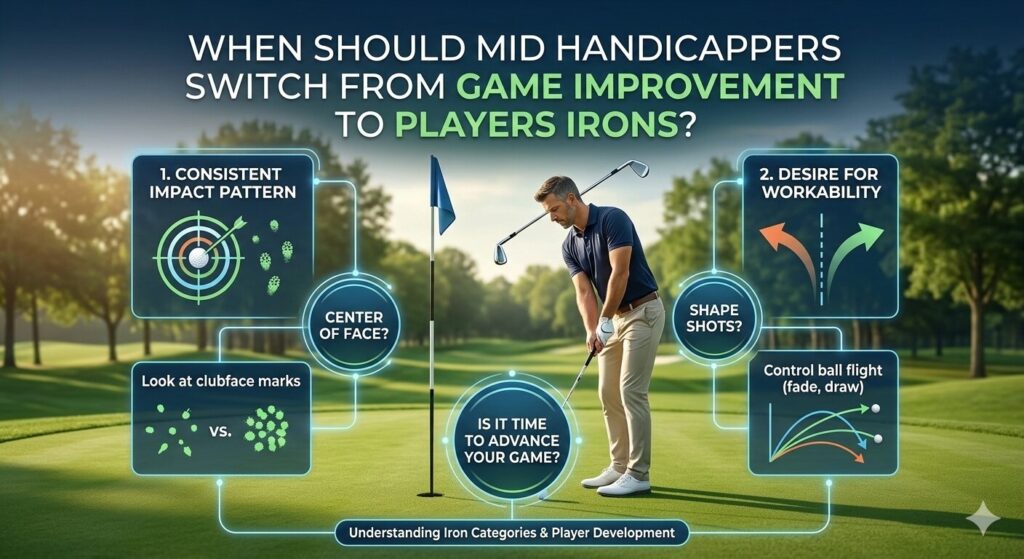
What’s the Actual Difference Between GI and Players Irons?
| Feature | Game Improvement Iron | Player’s Distance Iron | Pure Player’s Iron (Blade) |
| Head Size | Large, oversized | Mid-size | Compact, small |
| Offset | Significant offset | Minimal offset | None or near-zero |
| Sole Width | Wide for easy turf interaction | Medium | Narrow |
| Loft (7-iron) | 27–30° | 29–32° | 33–36° |
| Forgiveness | Maximum | High | Low |
| Feel / Feedback | Muted — forgiving | Medium — informative | Full — raw feedback |
| Who It’s For | 15–28 handicap | 8–18 handicap | 0–8 handicap |
The 5 Real Signals That You’re Ready to Make the Switch
These are the measurable, objective triggers that indicate a genuine readiness for player’s distance or player’s irons — not just a desire to feel like a better golfer:
Signal 1: Your Handicap Has Dropped Below 12 and Is Still Falling
A handicap below 12 doesn’t automatically mean you need to change irons. But if you’re trending downward — handicap falling from 15 to 13 to 11 over 18 months — your ball striking consistency is improving to the point where a player’s distance iron will develop your game further.
GI irons start hiding improvement opportunities once your ball striking is consistent enough to benefit from feedback.
Signal 2: You’re Hitting More Than 8 Greens in Regulation Per Round
Greens in Regulation (GIR) is the single best measure of iron performance. If you’re consistently hitting 8+ GIR per round, your ball striking has reached a level where the additional control of a player’s distance iron can help you hit closer to pins — not just onto greens.
GI irons prioritize getting you on the green. Player’s irons help you attack specific pin positions.
Signal 3: You’re Finding GI Irons Feel ‘Dead’ or ‘Numb’
This is a common experience among improving mid handicappers. The same muted, dampened feel that protected your confidence when you were a 18 handicapper now feels like it’s hiding information you want to have.
If you’re actively seeking the feedback of where on the face you struck the ball, you’re psychologically ready for irons that provide it.
Signal 4: Your Miss Pattern Has Become Predictable
High handicappers have random miss patterns — left, right, short, heavy, thin. The forgiveness of GI irons manages this randomness. Mid-low handicappers who are ready to move up typically have a consistent miss — always slightly right, always slightly thin.
A consistent miss can be addressed through technique. A player’s distance iron with honest feedback helps you identify and fix it faster than a GI iron that forgives it.
Signal 5: You Can Identify Your Strike Location Without Looking
Test this: after your next 10 iron shots, before looking at where the ball goes, say out loud where you think you made contact — center, heel, toe, slightly low.
If you’re right more than 70% of the time, your proprioception and ball striking awareness has developed to the level where player’s irons provide meaningful information rather than just punishment.
The Player’s Distance Iron — The Perfect Transition Club
Most mid handicappers making this transition shouldn’t jump straight to blades or muscle-back irons. The player’s distance iron category — the TaylorMade P790, Titleist T200, Srixon ZXi5, Callaway Apex Ai200 — is specifically designed for this transition.
It gives you the compact head shape and improved feedback of a player’s iron while maintaining enough forgiveness that your score doesn’t collapse during the adjustment period.
When Should You NOT Switch Yet?
- Your handicap is above 14 and hasn’t moved significantly in the last 12 months
- You still regularly chunk or thin more than 2–3 irons per round
- Your GIR average is below 5 per round
- You’re still working on the fundamentals of your swing rather than refining it
Which Player’s Distance Iron Is Best for the GI Transition?
If you’ve decided you’re ready to make the switch, our full guide covers the best mid handicap irons at every level: the best golf irons for mid handicappers — player’s distance picks tested and ranked